


GenAI for Good Challenge
Responsible AI. Deployed for good.
A global innovation initiative connecting teams building generative AI solutions with city governments across Europe and Central Asia to co-develop and deploy responsible, open-source AI for real urban challenges.

Applications Open 5 November 2026!
up to $40,000
Funding for Winning Teams
3 City Use Cases
Twin Transition: Green & Digital
Build to Scale
Real-world Deployment

Shape the Future of AI for Public Good
The GenAI for Good Challenge: Cities Edition pairs IEEE’s global network of engineers and technical experts with UNDP’s expertise and network of cities working to address development challenges through innovation — providing funding, technical frameworks, and structured collaboration with city stakeholders to help teams build, test, and deploy solutions designed for real municipal deployment.
The Challenge Cities
We’re looking for teams ready to put their GenAI expertise to work — where cities need it most. This Challenge centers on three real-world, city-owned use cases across Europe and Central Asia, each shaped by a partner city’s own priorities within the green and digital transition.

Modernizing Transit Route Reviews
City: Pristina, Kosovo1
Pristina is growing fast, and its bus routes need regular review to keep pace. This use case explores a multilingual GenAI assistant that helps municipal planners pull together transport routes, traffic data, and residents’ feedback so that the public transit system can adapt as the city grows.
Unlocking Energy Efficiency Investments
City: Rivne, Ukraine
Residents, homeowner associations and small businesses in Rivne want to cut costs and build energy resilience, but don’t know where to start. This use case explores a GenAI-powered energy efficiency assistant that walks users from a building profile to indicative costs, financing options, and a ready-to-share report.

Safeguarding Green Infrastructure
City: Skopje, North Macedonia
Skopje’s digital Green Cadastre keeps track of the city’s green infrastructure, including trees and green spaces. However, the records behind it are scattered across formats and departments. This use case explores how GenAI could connect those records to the Cadastre to support decision-making, ultimately safeguarding the city’s green infrastructure.
1 References to Kosovo shall be understood to be in the context of Security Council resolution 1244 (1999).

Tackle the green and digital transition with generative AI that makes cities better places to live.
Put your skills toward real problems in real cities across Europe and Central Asia, creating change the people living there can actually feel.

Build alongside IEEE HT and UNDP to develop responsible generative AI solutions cities can trust.
Draw on UNDP’s and its track record delivering innovation through BOOST and the City Experiment Fund.

Advance your innovation through a structured process built for deployment and impact.
Deploy your open source solution in partnership with organizations offering local and thematic expertise for real-world implementation.
UNDP’s City Experiment Fund collaborates with cities across Europe and Central Asia to tackle complex urban challenges through strategic innovation, and BOOST, UNDP’s regional impact acceleration programme, both financially supported by the Ministry of Finance of the Slovak republic.
Applicant Resources
Eligibility Criteria
- Platform Submission
Applicants must complete all mandatory Phase 1 submissions on both the Foundant and Zindi platforms (applications to be released with application open date) - Use Case Alignment
Proposed solutions must directly address a designated municipal use case in Pristina, Rivne, or Skopje. - 1- Year Commitment
In accordance with the official Terms and Conditions, teams are required to commit to participating across all stages of the competition throughout the coming year, including the sprint, prototyping, and piloting phases. - Team Composition
Teams must be informal groups of at least two (2) individuals (corporate entities or organizations are ineligible). Every team member must be 18 years of age or older. - Geographic Eligibility & Sanctions
Open to legal residents of the United States and international jurisdictions where permitted by local law, provided that no team member is subject to applicable sanctions or listed on relevant restricted-party lists, including United Nations and United States sanctions lists. Residents of any country or jurisdiction subject to U.S. Treasury Department (OFAC) sanctions are excluded from participation. - Open-Source Licensing
Teams must agree to release all project code, data, documentation, and models under an approved permissive open-source license (e.g., Apache 2.0, MIT, or equivalent) without seeking personal financial gain or patent rights. - GENIE. AI
Utilization of the GENIE.AI framework is strongly encouraged.
- Platform Submission
Evaluation Criteria
Phase 1 (Open Call):
- Step 1 (Technical Skills Assessment):
Candidates are filtered by performance through a skills assessment on the Zindi Platform. The top 100 technical performers move to panel evaluation. - Step 2 (Panel Review):
A panel reviews narrative submissions using the following core criteria:- Use Case Alignment (20%):
The application demonstrates a clear understanding of the city use case and showing how the proposed solution directly addresses its key challenges - Impact Potential (25%):
The application demonstrates expected value and outcome of deploying the solution using a responsible, inclusive, and open-source design - Team Capability (20%):
The application demonstrates technical expertise, related experience, and readiness to collaborate with the use case owner
- Use Case Alignment (20%):
Phase 2 (Semi-Finalists):
Reviewers will evaluate the updated narrative proposals, reflecting key insights and expertise gained during the Use Case Sprint, using the core evaluation categories listed in Phase 1 (Technical Approach, Impact Potential, Use Case Alignment, and Team Capability).Phase 3 (Finalists):
Reviewers will evaluate the prototypes and narrative applications and live pitch presentation on the core evaluation categories listed in Phase 1 (Technical Approach, Impact Potential, Use Case Alignment, and Team Capability).- Step 1 (Technical Skills Assessment):
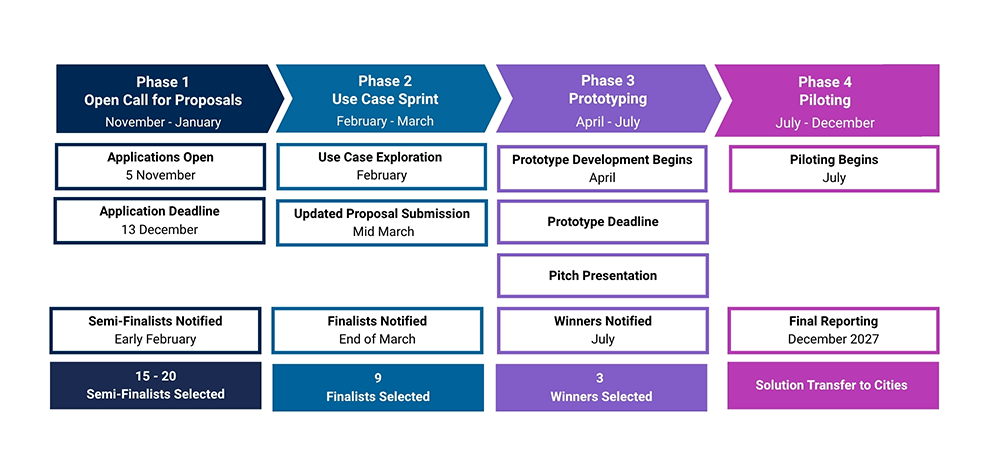
Challenge Journey
What's In It For You?
- Up to $40,000 in funding – $10,000 to build your prototype, plus up to $30,000 more if your team is selected to pilot it with a city.
- Real deployment – build your solution directly with a city government solving a problem they actually have, not a hypothetical.
- Expert mentorship – hands-on technical guidance from IEEE’s global network of engineers and reviewers, paired with UNDP’s public-sector and municipal expertise.
- A structured path from idea to impact – workshops, 1:1 sessions, and milestone-based support through a use case sprint, prototyping, and piloting.
- Global visibility – top teams pitch and showcase their work at a Pitch Competition, with a platform on the international stage.
- A real pathway to scale – successful pilots come with a plan for adoption and replication in other cities, not a one-off.
How to Apply
Deadline:
All steps must be completed by 13 December. Incomplete or late applications will not be considered for review.Step 1: Review Key Guidelines
Carefully review all eligibility requirements, challenge phases, and the project timeline.Step 2: Select Your Use Case
Read the full details of the specific Use Case you are applying to.Step 3: Submit Required Materials (All materials will be released by 5 November)
Complete and submit all three application components across their designated platforms:- Eligibility Quiz
A brief screening tool to verify your team’s eligibility. - Narrative Proposal (Funding Portal)
A structured proposal detailing your solution concept and problem-solving approach. - Technical Assessment (Zindi)
A practical skills evaluation to demonstrate your technical proficiency.
- Eligibility Quiz
Don’t Miss the Launch
Join the interest list to receive early updates, invitations to upcoming information sessions, and full application details as the GenAI for Good Challenge: Cities Edition launches.